.JPG)

Tuesday, March 3, 2015
Hawaiian Dress DIY

Monday, February 9, 2015
Jobs That Earn Income
First Grade
30 Min
Standard: Students explain how people in the school and community
use goods and services and make choices as both producers and consumers.
SS 1.4.3 Compare and contrast different jobs people do to earn
income.
Lesson Objective: Students will determine that people work jobs to earn income and differentiate between several jobs.
(Analysis)
Materials:
·
White paper
·
Crayons/ markers/ pencils
·
Income definition written down
·
White board and dry erase markers
·
Community jobs posters
·
Community Jobs books
Motivation: Quick draw- the teacher will pass out white paper. When
you hear the work job what do you think of? The students will have two minutes
to draw or write what they think of. The teacher will walk around and look at
the students work during that minute to see what the students already know. (Advance organizer). The teacher will
then have the students place that paper in their chair pocket so that it can be
accessible later.
Goal for learner: Today we are going to learn about income and different
jobs people do to earn income.
Procedure:
New Information: Raise your hand if you have ever heard the word
income. It looks like many (or some) of us have heard this word before. Income
is money someone receives for working. (Teacher will have the definition
written down so the students can see the word and read its meaning.) It is
important for people in the community to make money. People need money to buy
food and clothes and pay for a place to live. There are many ways that people
can earn income. Jobs are very important because they give people income. What
job do you think I will do to earn money? Teaching! Can you give me an example
of a job that people do to earn income? The teacher will get responses from
five students. Today, we are going to learn about these jobs. The teacher will magnet
the job cards for teacher, mail person, dentist, farmer, and baker to the
whiteboard. When people work all of these jobs they provide goods or services
to others. It is important to know what the people who work different jobs do.
Modeling: The teacher will point to the teacher card up on the
board. I am a teacher. There are many things teachers have to do. We teach
students, grade papers, and we help students learn.
Guided Practice: The students will write on the back of the sheet
they did their quick write on. They will write down their favorite job and write
what a person would do in that job. If they do not know, they may talk with a
person next to them. Cooperative
Learning. The teacher will also remind students that all of these jobs are
jobs that people work to earn income.
Check for Understanding:
·
How are all these jobs related? (analysis)
·
How are the jobs different? (comprehension)
·
What is it called when you earn money to help
pay for your house, clothes, and other things you need or want? (knowledge)
Practice
Application: Students will create a community jobs booklet. The students
will write on the line “I see” the name of the job depicted. On the “They” line
the students will write what a person who works that job does. On the final
page, students will answer what their favorite job is and what jobs are
important. Then the students can draw a picture of their favorite job.
Instructional Strategy: Cooperative Learning and Advance organizer.
Accommodations:
Low Ability: I will read the pages of
the book with the students if they struggle with reading. I can help students
spell words they are unsure of.
High Ability: Once the students are
finished with the book, they will write a list of other jobs on the back of the
book. All students will be told that once they finish they will do this, but
not all students will have time to.
Closure: Today, we learned about different jobs that people work to
earn income. We talked about teachers, mail people, bakers, farmers, and
dentists. It is important to know about different jobs that earn income so that
we can think about what types of jobs we would like to have.
Evaluation: The completion of the book “Community Jobs” will be the
evaluation.
|
Student name
|
Students fill out 1-2 pages correctly
(reteach lesson)
|
Students fill out 3-4 pages correctly
(basic)
|
Students fill out 5-7 pages correctly (Mastery)
|
|
|
|
|
|
Extension: The students will
be paired up and share their final page of the Community Jobs book with a partner. The partner will be the person
next to them.
Sources:
Informational:
(2015).
Income. Dictionary.com. retrieved
from: http://dictionary.reference.com/browse/income?s=t
Albanese.
(12 Mar. 2012). More writing center posters. Mrs. Albanese’s Kindergarten Class. Retrieved from: http://mrsalbanesesclass.blogspot.ca/2012/03/more-writing-centre-postersfreebies.html?utm_source=feedburner&utm_medium=email&utm_campaign=Feed%253A+MrsAlbanesesKindergartenClass+%2528Mrs.+Albanese%2527s+Kindergarten+Class%2529
Instructional:
Jobs. Take Charge America. Retrieved
from: http://www.takechargeamerica.org/wp-content/themes/tca/pdfs/teaching-resources/grade-one-jobs.pdf
Page,
K. Community Job Book. Teachers Pay
Teachers. Retrieved from: https://www.teacherspayteachers.com/Product/Community-Job-Book-874690
Thursday, February 5, 2015
School Lunch
We all know that school lunches are often frightening or consist of a basic assembly of "junk food". Those being either the mystery meat (in my elementary it was the strange little sausages that came with your french toast... also who ever thought french toast was a decent lunch?) or the corn dog and french fries. With all of the resources we have here in America you would think we could do better than this. Our first lady has her health kick but if you simply google school lunches you will hear that people are not satisfied. To me it seems that instead of providing healthier (as in more nutritious) meals, schools have just been cutting back on the amount of calories in the food. This does not make sense. To cut back on calories schools are simply providing less food. Less food is not what America is about!
Healthy eating is not eating less. So why are feeding our students less? Now, people may argue that schools do not have enough funding or resources to feed students foods rich in nutrients and low in calories and fat and that is a fair argument. But we live in America and that simply is not good enough. The biggest problem with unhealthy school lunches exist in the communities with limited resources. These communities have students who may only get food from their school. Now we are limiting the amount of food they get just so we can say our lunches are "healthy"? This is not okay!
Our first lady has made school lunches and healthier students her platform and we in schools appreciate that but unfortunately the results are less than ideal! It is time to revisit her original goal and realize we have gone off track. It is time to make school lunches truly healthy.
Wednesday, February 4, 2015
More on the Statue of Liberty
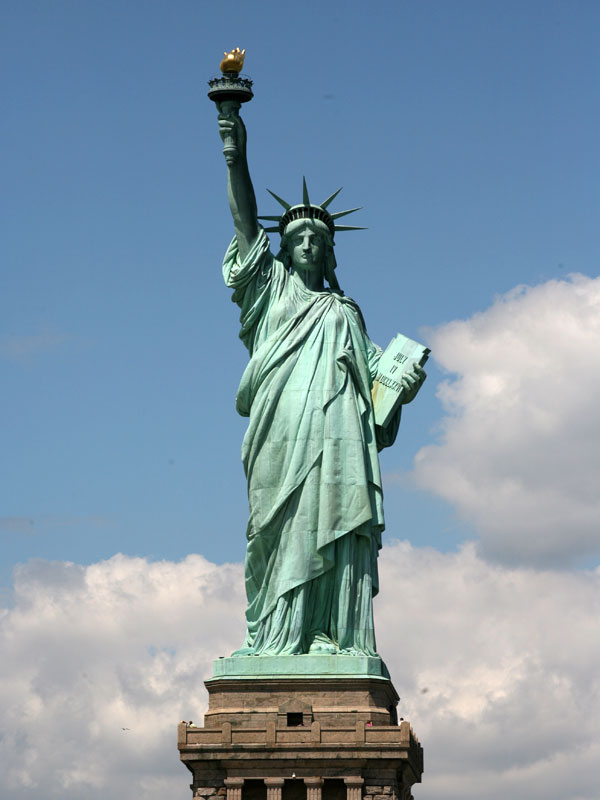
Today I taught my lesson on the Statue of Liberty. The students responded very well to the material. I spent twenty minutes on the new information, modeling, and guided practice and ten minutes to do the last activity. The students really loved the crowns and wanted to wear them the rest of the day.
My favorite part- The motivation with the live videos of the statue. unfortunately things were very foggy in New York today so I had to improvise but the students really enjoyed seeing the boats sail through the harbor.
One thing I wish I had done differently- I wish I had more visuals in the lesson. I should have had a powerpoint or a nearpod presentation for the students so that they could see the different parts of the statue other than on the small models that they were given to look at.
Overall the lesson went well and I feel the students will be able to identify the statue and explain why it is important. If I were doing this lesson in my own classroom I would go deeper in explaining each part (crown, torch, etc.) because the students seemed genuinely interested in the history behind it.
Link to the Statue of Liberty lesson
Tuesday, February 3, 2015
Education Policies
In one of my classes we read articles and write reflections over the reading. One of our readings discussed the idea of changes in education and conflicts within those changes.
Recently I had a discussion with one of my friends over the
inefficiencies in policies regarding schools and education. One of the sections
of the textbook I read begins by describing the great leaps we as a society
have made in education since the Second World War. When we discuss the
difficulties we are having in education policies it is important to remember
that historically we have not had such a great leap in education. Our laws and
policies have not yet caught up with the advances in education we have made.
There have been many attempts but ultimately it makes sense that things are not
in perfect harmony. We have made such huge advances in education and it has
been difficult for our government to catch up. We also cannot just abandon the
educational system we have in place. That is not how our system works.
Our system is based on representation. We elect people to
represent us and fight for what goods and resources we are allotted at what
time compared to others. The groups that are a majority tend to get the most amounts
of goods and resources first. Teachers are not a majority of the workforce so
our needs tend to be overshadowed by other needs like roads and bridges, which
everyone uses. The only other way to get the most amounts of goods and resources
first is to shout the loudest. Those who make their problems the most well know
are also allotted resources. Generally, teachers like to go with the flow. We
tend to not make a scene about our problems. If we really want to change things
we have to get more people involved in our cause. More people must understand
why it is important to make changes in our education system. If we choose not
to what we can to make the change we can hardly complain extensively about it.
We have to make a choice, we can either shout the loudest or do the best we can
with what we have.
Monday, February 2, 2015
The Statue Of Liberty
Grade Level: 1st
Lesson Topic: Statue
of Liberty
Subject:
Social Studies
Whole Group:
30 minutes
Standard: 1.1.3
Identify American songs and symbols and discuss their origins.
Lesson Objective: When
given a group of American symbols, students will determine which symbol is the Statue of Liberty and give an example of its importance. (Application)
Materials/Media:
·
Computer already open to Earthcam of the statue
·
White paper
·
Pencils, markers, crayons
·
Glue
·
Models of the Statue of Liberty
·
Crown (premade)
·
Facts on paper (precut)
·
The Statue
of Liberty; A Gift from France
Motivation: I
will show the students the live video of the views from and of the Statue of
Liberty. One of the videos shows the harbor and the boats sailing across the
water. Another shows the ground from the top of the statue. The final video
shows the statue from a distance across the harbor.
Goal for Learner: (make
sure to post the objective) Today we
are going to learn about one very important American symbol, the Statue of
Liberty. We are going to learn the different parts of the Statue of Liberty and
why it is an important American symbol.
Procedure:
New Information:
The teacher
will split the students into groups of five (23 students, five groups, three
groups of five and ) Cooperative
Learning. The students will be told the expectations about sharing the
models; each student will get a chance to hold the model. The teacher will give
each group a model of the statue. The students will examine the model of the
Statue of Liberty. The teacher will prompt the students’ investigation with the
following questions, one for each group: Where do you think the Statue is
located? What do you think the statue is made of? Where did the statue come
from? Why is it important? The groups will also be asked to describe the
statue. The teacher will then call the attention back to the front of the room
and collect the statues. The teacher will ask the students what they observed.
The teacher will write the observations in a chart (example below). After the
chart is filled out the teacher will go though the students observation and
explain their importance as well as adding any other important information (as
follows). For the information the students do not state the teacher will pull
out the book, The Statue of Liberty,
and show the pictures while explaining the information on the page.
·
The statue is made of copper. Copper turns green
when it gets old.
·
France gave the statue to America because our
countries are allies/ friends. France gave the statue to America exactly 100
years after the Declaration of Independence. On the tablet she is holding it says July IV
MDCCLXXVI, which means July 4, 1776. The day and year are written in roman
numerals, which are a different form of numbers. That is the year the
Declaration of Independence was made.
·
The Statue of Liberty wears a crown with seven
points on it to symbolize the seven continents and seven oceans. The teacher
will show the students a map of the world with the seven seas and continents
labeled.
·
·
The statue is wearing a robe like the Roman
goddess of freedom because the statue is an American symbol of freedom.
·
It is an important symbol of freedom because when
people in the past moved to America one of the first things they saw was the
Statue of Liberty. Those people wanted to live in America because they would be
free. The word liberty means freedom. That is why the Statue of Liberty is an
American symbol of freedom.
Chart:
Description
|
Purpose
|
Importance
|
Made of copper
|
Gift from France
|
In New York
|
Crown
|
Symbolizes freedom
|
People moving to America see it
|
Wears a robe
|
Liberty means freedom
|
|
Holds a tablet
|
||
Holds a torch
|
Nonlinguistic
Representation
Modeling: The teacher will hold up the book The Statue of Liberty. While I was reading this book, I read a very
interesting fact. I read here that the person who created the Statue of Liberty
was named Federic Bartholdi. I think that is a very interesting fact because he
must have been a very good artist to create such an important statue.
Guided Practice: Can a few students tell me an interesting fact
about the Statue of Liberty? Why is that fact interesting to you? Remember
facts are things that are true. The teacher will call on several students to
answer the question. The teacher will have an example crown and write the facts
on a crown so the students can see.
Check for Understanding:
·
What are the parts of the Statue of Liberty?
·
How do the parts of the statue symbolize
freedom?
·
How is the Statue of Liberty related to France?
Practice/ Application: Students will get a crown made out of a
paper plate. They will also receive a set of facts and pictures on small pieces
of paper. These materials will all be premade. Students will write their name
on the back of the crown. The students will select the facts that are true and
glue them on to the points of the crown. There are six facts for each of the
points with the middle point labeled “Statue of Liberty.”
Instructional Strategy: Cooperative Learning and Non-linguistic representation
Accommodations:
Low Ability: Reading written
text aloud so that students that struggle with reading can complete the work, students
will be placed into groups and be able to learn from their peers.
High Ability: Students can work
more independently. Students will be asked to think more deeply about their
responses to teacher questions.
Closure: Can anyone tell me what we have learned about the Statue
of Liberty? We have learned that the statue was a gift from France and is a
symbol of freedom in America. Can you list the parts of the Statue of Liberty?
The parts are the crown, torch, tablet, and robe. It is important to know the
things we have learned about the Statue of Liberty because we live in America.
The statue is a symbol of the country we are a part of.
Evaluation: The students
will be evaluated on the completion of their crown activity.
Rubric:
Reteach lesson
|
Review important details
|
Mastery
|
Student chose 0-2 facts correctly.
|
Student chose 3-4 facts correctly.
|
Student chose 5-6 facts correctly.
|
Extension: The students will write about why the Statue of Liberty
is important to them as people in America. The students may also draw a picture
of the statue once they have written about why it is important to them.
Sources:
Informational
Sources:
(2014). The
Statue of liberty facts. Softschools.com.
retrieved from: http://www.softschools.com/facts/us_national_landmarks/the_statue_of_liberty_facts/513/
This resource includes
valuable facts about the statue of Liberty that students need to know to
understand the importance of this symbol.
(2015). Statue of
liberty cams. Earthcam. Retrieved from: http://www.earthcam.com/usa/newyork/statueofliberty/?cam=liberty_torch
This resource includes
live videos of what is happening at the Statue of liberty in real time. The
videos include views from the statue and of the statue. The students will be
able to view these videos to get a good idea of what the statue looks like.
Talley, C. The Statue of liberty; A gift from france. New
Jersey. Pearson.
This resource includes many facts
about the statue and can be used to supplement instruction.
Instructional Resources:
Creating a
Symbol. National parks service. Retrieved
from: http://www.nps.gov/stli/forteachers/upload/Celebrating-a-symbol-FINAL.pdf
This resource from the
National Parks service is a lesson plan for teachers who are taking their
students to the Statue of Liberty. The resource gives several examples of
activities to do with students to learn about the statue.
Hastings, L.,
Smith, B. (2005). Symbols of freedom. Core
Knowledge Foundation. Retrieved from: http://coreknowledge.org/mimik/mimik_uploads/lesson_plans/514/Symbols%20of%20Freedom2.pdf
Subscribe to:
Comments (Atom)